
Hi, it’s Patrick.
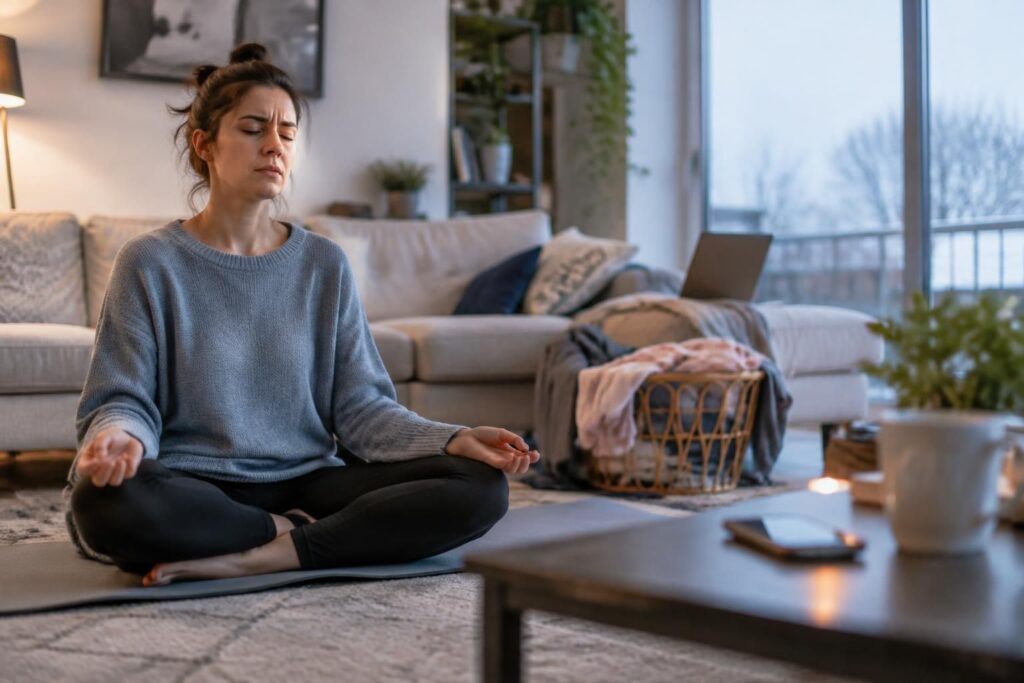
If your relaxation exercise isn’t working for you at home, first adjust its duration, timing, and method instead of forcing yourself to “do it right.”
Relaxation can’t be switched on at will. Stress, distractions, or instructions that don’t suit you can keep your body on high alert, even during an exercise that’s supposed to calm it.
Why your relaxation exercise isn’t working at home
An exercise can be effective in theory and still be poorly suited to how you’re feeling in the moment. If you’re very restless, sitting still in silence can make you more uncomfortable instead of easing that discomfort.
To find a more suitable approach, you can compare these reasons why abdominal breathing can sometimes feel difficult and try a few simple exercises for when everything feels overwhelming. The right exercise is one you can practice without putting yourself under more pressure.
Try this right now
- Shorten the duration: start with 2 to 5 minutes rather than aiming for a long session.
- Choose a comfortable posture: sit, stand, or lie down without looking for the perfect position.
- Relax one specific area: unclench your jaw or lower your shoulders before continuing.
- Remove distractions: turn off notifications and put your phone out of reach.
- Notice without judging yourself: notice the thoughts that come and go, then gently bring your attention back to the exercise.
A common pitfall is expecting to feel calm immediately. If you keep checking whether you’re relaxed yet, your focus shifts to the result rather than the sensations you’re experiencing in the present moment.
Mistakes that keep stress going during relaxation
Relaxation practice isn’t a test you have to pass. Trying to completely clear your mind, breathe in a highly controlled way, or eliminate all muscle tension can turn a calm moment into another source of effort.
Unrealistic expectations and choosing the wrong method
Meditation isn’t necessarily right for everyone or for every moment. When your thoughts are racing, a gentle physical activity or simple breathing techniques may feel more accessible than a long, motionless session.
Imagine Léa, who tries to meditate after a noisy day at work. She gets impatient because her mind is still active; by replacing the session with a few slow movements and a comfortable exhale, she finds something more concrete to focus on.
| What you notice | Possible cause | Try this |
|---|---|---|
| You monitor every breath | You’re trying to control your breathing | Let the air flow in and out without setting a rhythm |
| You feel restless while staying still | The posture or method doesn’t suit you | Try a slow walk or a gentle stretch |
| You’re interrupted often | Your quiet environment isn’t protected well enough | Choose a quieter time and turn off alerts |
| You give up after a few tries | You’re expecting an immediate effect | Keep your sessions short and notice how you feel afterward |
Your surroundings matter too, but they don’t have to be perfect. To support your well-being at home, a comfortable place and a few minutes without interruptions may be enough; practicing regularly often matters more than having one exceptional session.
Adapt the exercise to your level of tension
If you feel slightly tense, a few slow breaths can help you pause. If you feel very restless, try moving gently or relaxing one part of your body first, then return to your breathing if that feels right.
Avoid forcing yourself to breathe deeply if it makes you dizzy or increases your discomfort. Return to your natural breathing and stop the exercise if your symptoms persist or get worse.
A 3-step process to make relaxation useful again
- Notice how you feel to start with. In a few words, note whether you feel restless, tired, or tense. Then choose an exercise that suits how you feel, rather than the one that seems most impressive.
- Try a short session. For 2 to 5 minutes, focus on just one thing: your feet on the floor, your shoulders, or the natural movement of your breath. If an instruction makes you more tense, set it aside.
- Assess the effect without expecting perfection. After the session, ask yourself whether you feel a little calmer, the same, or more uncomfortable. Adjust the method next time and keep what genuinely helps you.
This approach turns stress management into a simple experiment rather than an obligation to feel good. Progress can be modest: a less clenched jaw or an easier pause to return to.
Should you practice every day?
Not necessarily. A few minutes of practice, repeated at a realistic pace, may be easier to maintain than a strict program that becomes a burden.
Why does relaxation sometimes make me feel more restless?
Silence or focusing on your body can make sensations and thoughts more noticeable. Try a moving practice, a shorter duration, or an external point of focus, and stop if your discomfort increases.
How long does it take for a relaxation exercise to help?
There is no set duration that works for everyone. Start with 2 to 5 minutes and notice the effect without expecting your stress to disappear completely.
What should I do if breathing techniques don’t suit me?
Don’t force your breathing. You can focus on the support beneath you, gently relax your shoulders, or walk slowly.
How can I keep up a regular practice without putting pressure on myself?
Choose a time that’s easy to stick to and keep your session short. It’s easier to build a regular practice when it suits you than when it follows a rigid rule.
I hope you’ve found these tips helpful. See you soon! — Patrick