
Hi there, it’s Patrick.
To ease stress in the moment, start with slow, steady breathing; to release lasting tension, progressive muscle relaxation tends to have a more lasting effect.
No technique works for everyone. The right exercise is one you can repeat without putting pressure on yourself.
Relaxation techniques for stress: which one should you choose?
Deep breathing is quick to practice, while mindfulness meditation helps you gain perspective, and sophrology often combines breathing, relaxation, and visualization. Here are five simple things to try to find out what really calms you.
Try these right now
- Lengthen your exhale: breathe in gently, then breathe out for a little longer, for one to two minutes.
- Try coherent breathing: breathe in for about five seconds and out for five seconds, without forcing it.
- Relax your shoulders: tense them slightly for a few seconds, then release them.
- Come back to the present: name three things you can see and two physical sensations.
- Choose a regular time: practice for a few minutes at a time that’s easy to stick to, rather than waiting until you feel overwhelmed.
To understand why some methods calm the body, learn how relaxation techniques calm underlying stress. If you want to compare several practices, these five exercises to try for stress offer some other practical ideas.
Breathing, meditation, or muscle relaxation: what’s the difference?
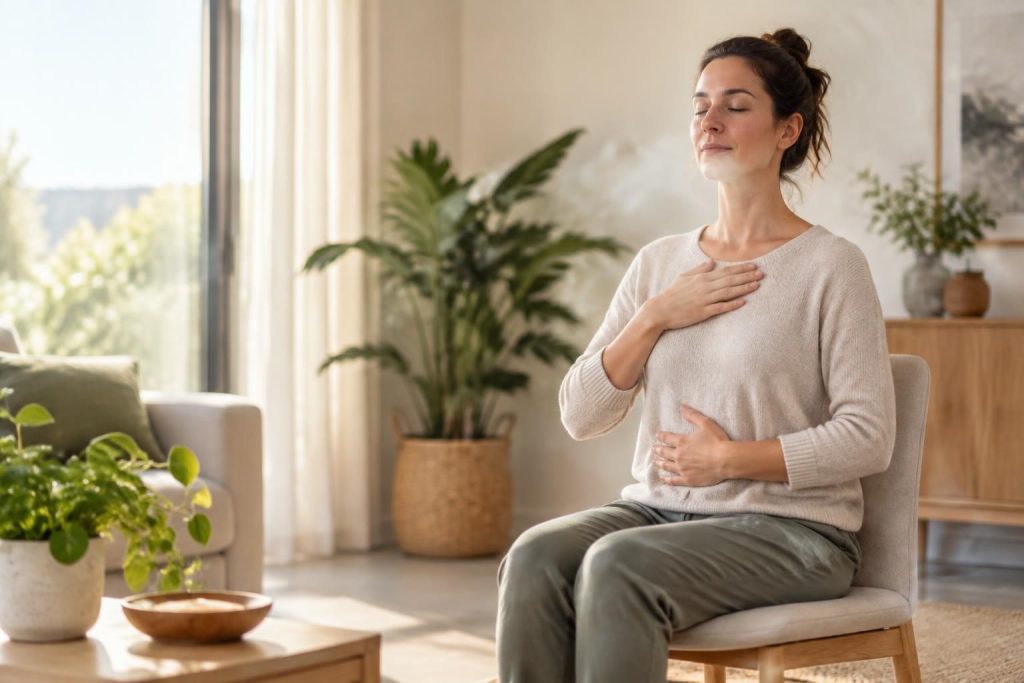
Slow breathing is often the easiest option when tension rises: it requires no equipment or special setting. Coherent breathing is a structured form of breathing exercise; keep a comfortable pace and stop if you feel dizzy.
Mindfulness meditation requires a little more time and attention. It involves observing thoughts and sensations without trying to push them away. Progressive muscle relaxation alternates gentle tensing and releasing of muscle groups; it can be useful when stress shows up as a clenched jaw or tense shoulders.
| Technique | Best when… | Simple way to try it |
|---|---|---|
| Deep breathing | You need a quick break | A few slow exhales |
| Coherent breathing | You want to follow a steady rhythm | About five minutes, without forcing it |
| Mindfulness meditation | You want to observe your thoughts with perspective | Two to five minutes of focusing on your breath |
| Progressive muscle relaxation | You feel tension in your body | Tense and then release one area at a time |
| Sophrology | Breathing and mental imagery appeal to you | A short guided visualization |
Which exercise for stress really works over time?
Imagine Samira, who ends her workdays with tense shoulders. She tries deep breathing before a meeting, then muscle relaxation in the evening: the first helps her take a break, while the second encourages her to notice and release physical tension.
This small example illustrates a useful rule: measure the effect according to what you need, not against a universal promise. When it comes to managing stress, regular practice matters more than one long session.
A three-step process for finding your technique
- Identify the main signal: shortness of breath, racing thoughts, or tense muscles. This can help you choose an appropriate exercise.
- Try one method: practice it for three to five minutes at a calm time, over several days. Simply note whether you feel more settled or more tense.
- Adjust without judging yourself: keep the exercise that helps you and switch methods if it becomes uncomfortable. Stress reduction can’t be forced; it develops through realistic practice.
A common pitfall is trying to “succeed” at relaxation and getting frustrated as soon as your mind wanders. Gently returning to your breath is already part of the exercise: stress-relief techniques are tools, not a test.
If anxiety becomes overwhelming, disrupts your sleep, or limits your activities, seek advice from a healthcare professional. These exercises can support your well-being, but they’re not a substitute for appropriate care.
Which relaxation exercise is quickest for stress?
Slow breathing with a slightly longer exhale is easy to try for one to two minutes. It isn’t right for everyone: return to your natural breathing if it causes discomfort.
How long should you practice coherent breathing?
You can start with a few minutes at a comfortable pace, around five seconds in and five seconds out. There’s no need to force it or stick to this rhythm if it makes you uncomfortable.
Does mindfulness meditation work for everyone?
It can help you observe your thoughts with greater perspective, but some people prefer breathing exercises or muscle relaxation. Try it briefly and choose the practice that suits you.
When should you ask for help managing stress?
If stress persists, affects your sleep, or interferes with daily life, talk to a healthcare professional. Relaxation can complement care, but it can’t replace it.
I hope you found these tips helpful. See you soon! — Patrick