
Hello, it’s Patrick.
Five simple exercises — deep breathing, muscle relaxation, meditation, positive visualization, and stretching — can help you ease stress.
When the pressure builds, a few minutes are enough to break the automatic cycle and find a little relaxation. The key is to choose something easy to repeat, without trying to do it perfectly.
Try this right away
- Breathe slowly: breathe in through your nose, then breathe out gently without forcing it.
- Relax your muscles: tense and then relax your shoulders and hands.
- Come back to the present: notice the sounds, sensations, and colors around you.
- Picture a calming place: call to mind a familiar, pleasant image.
- Stretch gently: loosen your neck and upper back without making any sudden movements.
To find a practice that works for you, you can explore three easy methods for when everything feels overwhelming and compare mental and muscle relaxation exercises. A useful technique is, first and foremost, one you can return to without putting pressure on yourself.
The trap to avoid when stress builds
Trying to make stress disappear immediately can add yet another demand. If your mind stays busy during meditation, that’s not a failure: simply notice the distraction, then bring your attention back to your breathing.
Another habit to avoid is taking big, forced breaths. Deep breathing should remain comfortable. If you feel dizzy, return to your natural breathing and stop the exercise.
5 relaxation exercises to calm stress
1. Deep breathing and heart coherence
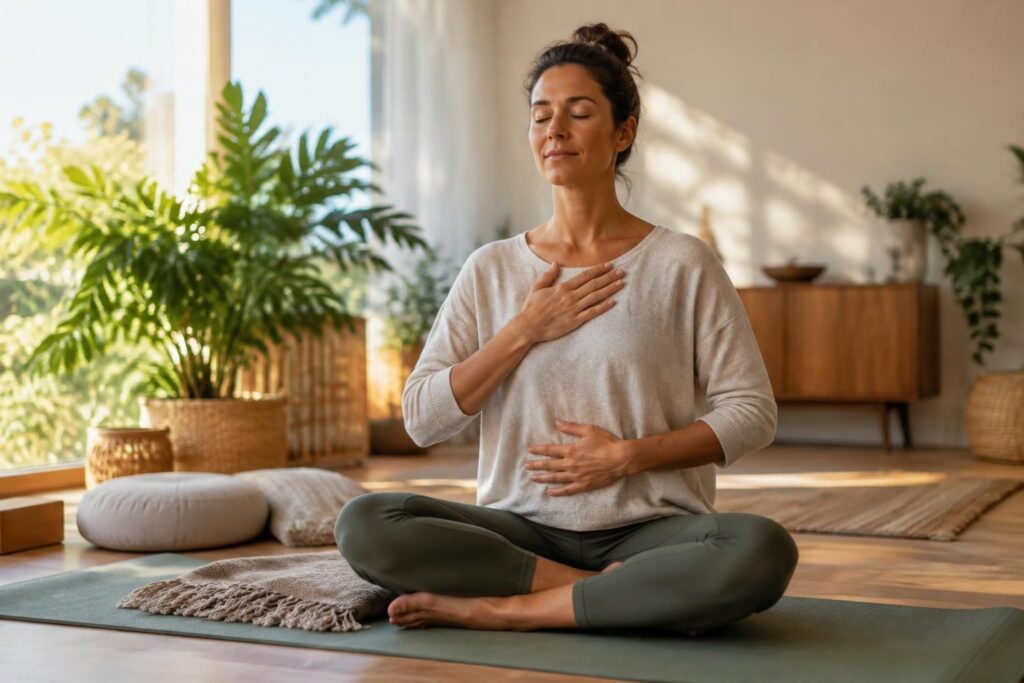
Sit with your feet on the floor. Breathe in gently for about five seconds, then breathe out for five seconds, and repeat for a few minutes if it remains comfortable.
This rhythm, often used in heart coherence practice, gives your attention a regular point of focus. It doesn’t suit everyone in the same way: slow down or return to your natural breathing if you feel uncomfortable.
3. Mindfulness meditation
For a minute or two, focus your attention on one specific thing: the feeling of your feet on the floor, the movement of your belly, or the sounds in the room. When a thought comes along, notice it without judging it, then return to that sensation.
Mindfulness isn’t about emptying your mind. Instead, it trains you not to follow every stressful thought as if it required an immediate response.
4. Positive visualization
Picture a place that makes you feel safe or calm, whether real or imagined. Add a few sensory details: the light, the sounds, the temperature of the air.
For example, before a stressful meeting, you can spend a minute imagining this scene and relax your shoulders as you breathe out. Positive visualization offers a mental break; it doesn’t replace solving a practical problem.
5. Gentle stretches
Sitting or standing, slowly tilt your head to one side without pulling on it, then bring it back to the center. Roll your shoulders backward and stretch your arms within a comfortable range of motion.
These simple movements can help after a long time in front of a screen. Stay within a comfortable range and stop if you feel any pain: the goal is to loosen up your body, not to force it.
Choose an exercise based on the moment
You don’t need to do all five in a row. Léa, for example, can take a few slow breaths out before a meeting, then stretch her shoulders after sitting for a long time.
| Moment | Exercise to try | Suggested duration |
|---|---|---|
| Before a stressful situation | Slow breathing | 2 to 5 minutes |
| After a stressful day | Muscle relaxation | 5 to 10 minutes |
| When your thoughts start racing | Mindfulness | 1 to 3 minutes |
| Before going to sleep | Positive visualization | A few minutes |
| After sitting for a long time | Gentle stretches | 2 to 5 minutes |
A three-step stress-relief routine
- Identify what you need: restlessness, physical tension, and repetitive thoughts don’t necessarily call for the same exercise.
- Choose a short practice: start with two minutes and keep your breathing natural.
- Notice the effect: see whether your body or attention feels a little calmer, then adjust next time.
Consistency matters more than a perfect session. If stress persists, disrupts your daily life, or causes significant distress, talk to a healthcare professional.
How long should you practice a relaxation exercise?
You can start with one to five minutes. Only continue longer if the exercise remains comfortable and useful for you.
Which exercise should you choose when stress builds quickly?
Try a slow exhale or a grounding exercise by noticing the sensations in your feet on the floor. If focusing on your breath bothers you, choose gentle stretches instead.
Is heart coherence suitable for everyone?
It can be uncomfortable for some people. Breathe naturally if you feel dizzy or uncomfortable, and ask a professional for advice if needed.
Can you practice these techniques at work?
Yes. A few slow breaths out, a brief return to present sensations, or gentle shoulder movements can be done discreetly, without any equipment.
I hope you found these tips helpful. See you soon! — Patrick